Form Settings
Customize every aspect of your form: notifications, automated responder emails, custom redirects, branding, allowed domains, submissions archiving, analytics, and file uploads.
General Settings
Under the General Settings card in your form's dashboard, you can control the core operational behavior of your form:
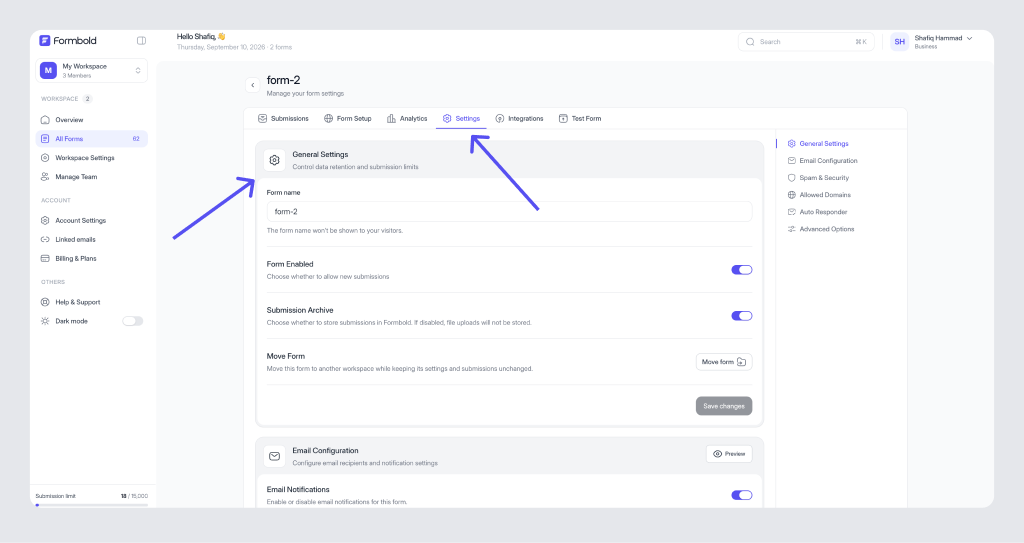
- Form Name: An internal title to help you organize and identify forms across multiple client projects or workspaces. This name is never visible to the end user.
- Form Enabled: Toggle whether your form is active. When disabled, incoming submissions will be gracefully rejected without storing records or dispatching alerts.
- Submission Archive: Control whether FormBold stores submission data and uploaded files in the database. When turned off, submissions are dispatched to notification channels in real-time but not retained on FormBold servers.
- Workspace Folder: Organize forms by moving them into project folders within your workspace.
Email Notifications & Delivery
FormBold delivers instant email notifications for every valid form submission. You can fine-tune delivery with precision:
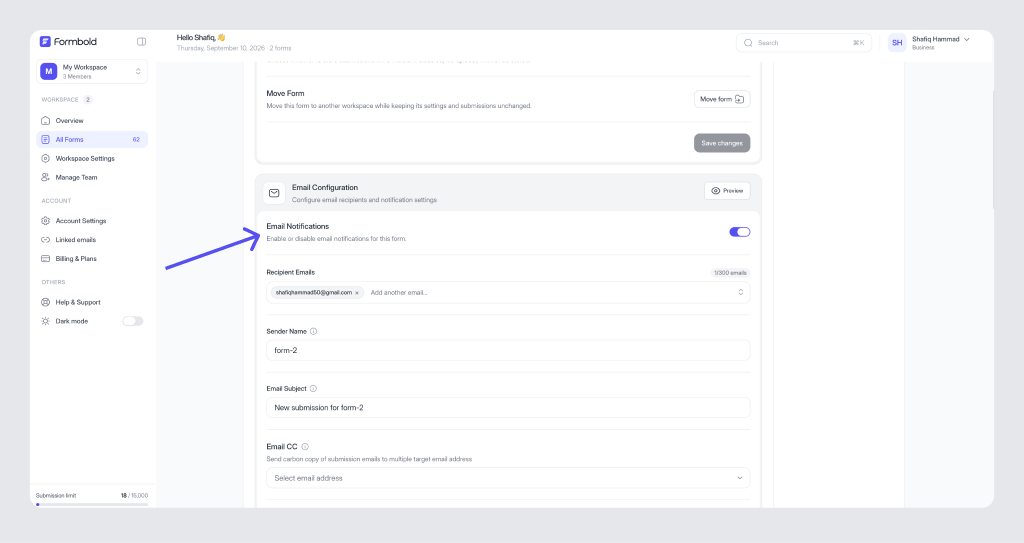
- Email Notifications Toggle: Enable or pause email alerts at any time. When paused, submissions are still securely logged in your dashboard and sent to active app connectors.
- Target Email: Select the primary recipient for submissions. You can choose from any of your verified Linked Email Addresses in your account.
- Adding Linked Email Addresses: To send notifications to team members or clients, go to Account Settings > Linked Email Addresses, enter the email, and verify ownership via the confirmation link.
- Email CC (Carbon Copy): Send duplicate copies of form submissions to a secondary address for archiving or management review.
- Custom Email Subject: Personalize the subject line of notification emails. You can use dynamic template variables such as {{name}}, {{email}}, and {{form}} (e.g. 'New Inquiry from {{name}} - {{form}}') to triage submissions easily in your inbox.
Automated Responder (Auto-Responder)
Send an automated, personalized confirmation email back to submitters immediately after they complete your form. Perfect for acknowledging contact requests, sending receipt confirmations, or providing onboarding links.
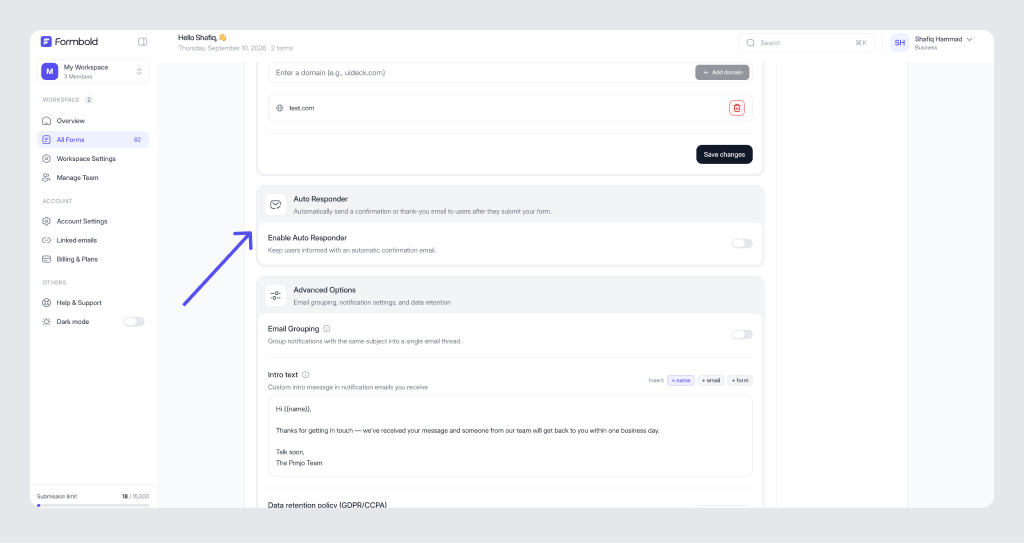
How to configure Auto-Responder:
- Navigate to your form's Settings tab and scroll to the Auto-Responder card.
- Toggle the Auto-Responder switch to ON.
- Set the Sender Name (e.g., 'Acme Support Team' or your company name).
- Set the Auto-Response Subject line (e.g., 'Thank you for reaching out to Acme!').
- Draft your personalized message body. You can use markdown to style links and bullet points.
- Ensure your HTML form includes an input with name='email' so FormBold knows where to send the response.
Anti-Spam Note: To protect your sender reputation and prevent automated mail loops, we strongly recommend enabling Basic Spam Filter or reCAPTCHA whenever Auto-Responder is active.
User Experience & Redirects
Control what visitors see immediately after submitting a standard HTML form:
- Redirect URL: Provide a custom URL (e.g., https://yourdomain.com/thank-you). After a successful POST submission, visitors will be automatically redirected to this page.
- Custom Success Message: If you do not specify a redirect URL, FormBold displays a clean, responsive confirmation screen with your custom message.
Email Branding & Whitelabeling
Reinforce your brand identity by adding your custom logo to submission notification emails:
- Supported Formats: PNG or JPG image files.
- Recommended Dimensions: 300px width by 56px height.
- File Size Limit: Maximum 2MB.
- When configured, your logo replaces the default FormBold badge in the email header and footer.
Allowed Domains (CORS Security)
Protect your form endpoints from unauthorized third-party misuse, scraping, or cross-site spoofing by restricting origins:
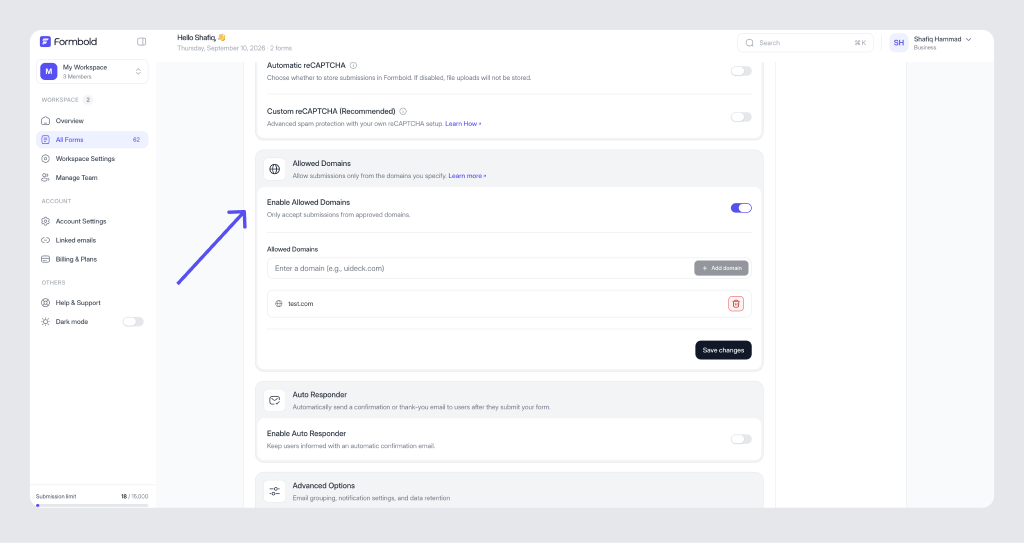
- Enable the Allowed Domains toggle in Form Settings.
- Enter your authorized domains (e.g., yourdomain.com, staging.yourdomain.com).
- Any submission originating from an unlisted domain will be automatically rejected with an HTTP 403 Forbidden response.
File Uploads & Attachments
FormBold supports file attachments directly through standard HTML file inputs:
<form
  action="https://formbold.com/s/YOUR_FORM_ID"
  method="POST"
  enctype="multipart/form-data"
>
  <label for="email">Your Email:</label>
  <input type="email" name="email" id="email" required />

  <label for="resume">Attach Resume (PDF, DOCX):</label>
  <input type="file" name="resume" id="resume" />

  <button type="submit">Submit Application</button>
</form>
Key details for file uploads:
- Always include enctype='multipart/form-data' on your form tag.
- Maximum file size is 5MB per upload (available on Pro and Business plans).
- Uploaded files are safely stored for 30 days and can be downloaded anytime from the Submissions dashboard table.
- Attachments are also included as direct links or email attachments in your notification emails.
Submissions Management & Data Export
FormBold provides a full-featured submissions management interface (/account/forms/[id]/submissions):
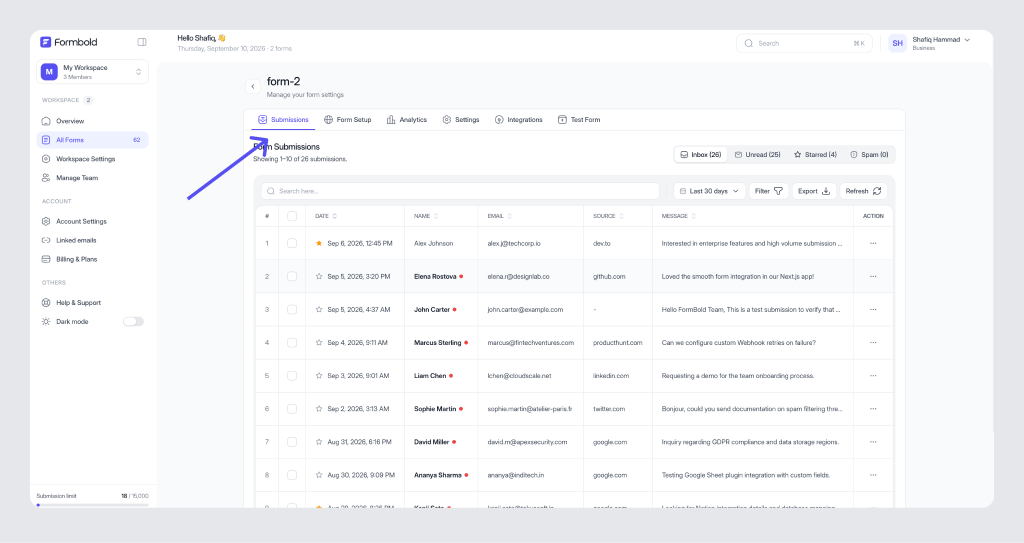
- Filter Tabs: Organize submissions by Inbox, Unread, Starred, or Spam.
- Search & Date Filtering: Instantly locate responses by keyword, email, or date range.
- One-Click Data Export: Export your complete submission archive as clean CSV or JSON files for external spreadsheets or data pipelines.
- Submission Detail Drawer: Click any row to view client metadata (IP address, geographic location, user agent, browser, OS, and timestamp) with actions to star, delete, or mark unread.
Form Analytics & Conversion Tracking
Gain actionable insights into your form performance (/account/forms/[id]/analytics):
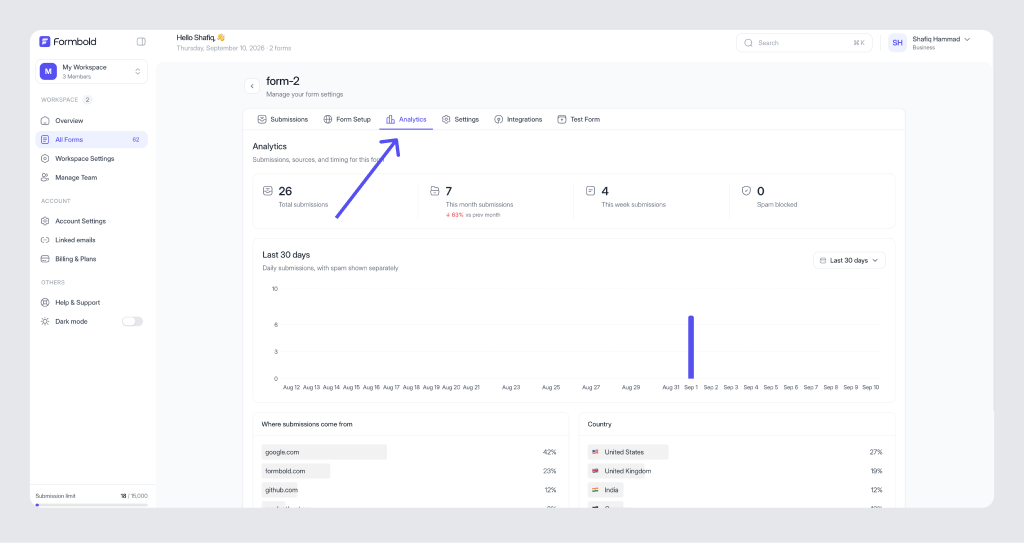
- Key Metrics: Total views, submissions, and conversion rate percentage.
- Visitor Trends: Interactive charts showing daily, weekly, and monthly submission volume.
- Demographics Breakdown: Detailed tables displaying visitor countries, browsers, operating systems, and device types.
Advanced Options & GDPR Data Retention
Fine-tune backend data handling with advanced preferences:
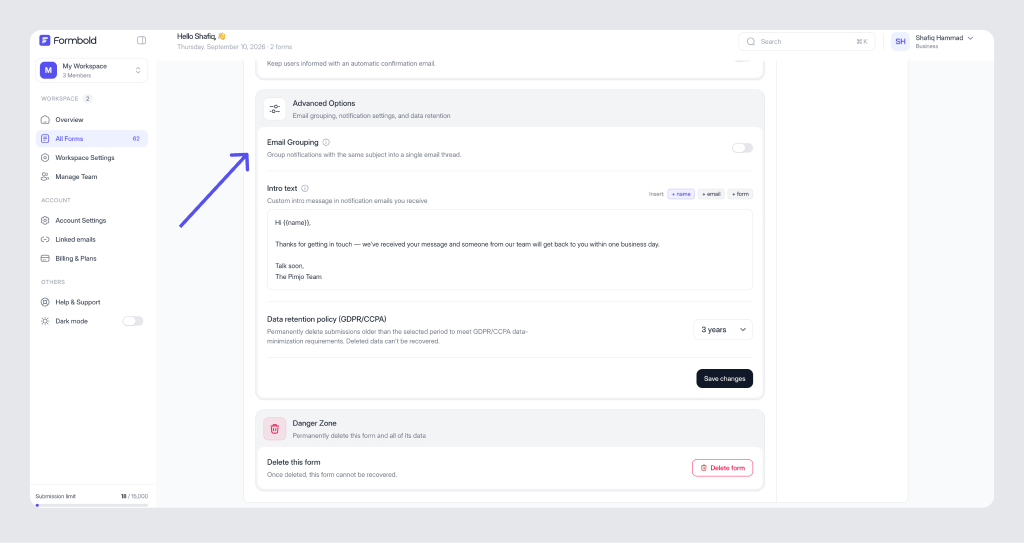
- Email Grouping Threads: Choose whether notifications arrive as grouped conversation threads or individual standalone emails.
- GDPR Auto-Delete Retention: Set an automatic data deletion schedule (e.g., auto-purge submission data after 30, 60, or 90 days) to comply with data privacy policies.
- Danger Zone: Permanently delete a form and all its historical submission records.
Last updated: September 10, 2026